3 months Premium FREE
No credit card. No commitment.
McDonald’s Corporation
🇺🇸 MCD · NYSE/NASDAQ
Consumer
Price at analysis: USD 242.74 Current price: USD 240.41 * updated every night
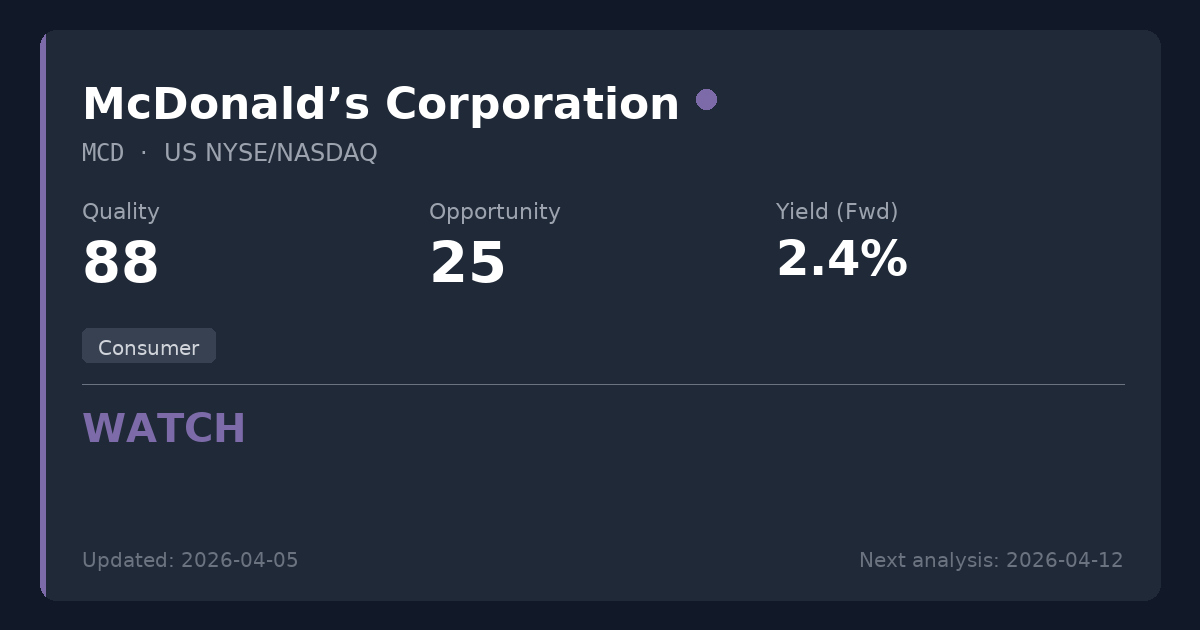
Scores
Key Metrics
Powered by EODHDP/E (TTM)
19.7
P/E (Price-to-Earnings)Shows how much investors pay for each $1 of profit. We display the TTM P/E (Trailing Twelve Months) which uses actual earnings from the last 4 quarters. This is more reliable than Forward P/E which uses analyst estimates.
Calculation: 242.74 ÷ 12.30 = 19.7
TTM period through: 2026-06-30
Forward P/E (estimated): 17.1
Based on analyst estimates
Reference: Provider P/E (Trailing): 19.2
Net Debt/EBITDA (TTM)
3.6x
Latest quarter: 13.8x
Net Debt / EBITDAA leverage ratio showing how many years of EBITDA (earnings before interest, taxes, depreciation, and amortization) it would take to repay net debt. EBITDA approximates operating cash generation. Lower ratios (e.g., <3x) are generally safer; higher (e.g., >5x) may indicate more financial risk.
TTM through: 2026-06-30
Latest quarter (2026-06-30): 13.8x
The quarterly value can spike when quarterly EBITDA is very low (e.g., one-time charges).
Quick guide: <2x manageable, >4x can be risky (sector-dependent).
EV/EBITDA
18.8x
EV/EBITDAA valuation ratio that compares total business value (including debt) to EBITDA. Lower can mean cheaper, but context matters.
Dividend Summary
Powered by EODHDDividend Yield (Fwd)
2.64%
TTM: 3.08%
Dividend YieldThe Forward yield (Fwd) shows the next announced annual dividend / current price — what you'd earn going forward. The Trailing yield (TTM) in the tooltip shows dividends actually paid in the last 12 months. Forward is shown as primary because it reflects the company's current commitment to shareholders.
Forward Yield (estimated): 2.64%
Trailing Yield (TTM, last 12 months): 3.08%
Payout Ratio (Fwd)
62.8%
TTM: 59.5%
Payout RatioDividends as a percentage of earnings. The Forward payout (Fwd) uses the announced dividend divided by actual past earnings (TTM) — it tells you if the company can afford what it promised. Very high payouts can be risky, especially if profits fall.
Announced dividend / actual earnings (TTM)
Payout (Fwd): 62.8%
Payout (TTM): 59.5%
Cash Flow Payout (TTM): 46.0%
FCF Coverage (TTM): 1.49x
Growth Streak
8 yrs
Consec. increases
Div. Growth (5Y)
7.3%
Dividend History
EODHD Dividends API| Status | Type | Decl. Date | Ex-Div Date | Pay Date | Currency | Amount |
|---|---|---|---|---|---|---|
| Forecast* | Quarterly | — | 01 Sep 2027 | — | USD | 1.86 |
| Forecast* | Quarterly | — | 02 Jun 2027 | — | USD | 1.86 |
| Forecast* | Quarterly | — | 03 Mar 2027 | — | USD | 1.86 |
| Declared | Quarterly | 17 Sep 2026 | 01 Dec 2026 | 15 Dec 2026 | USD | 1.93 |
| Paid | Quarterly | 23 Jul 2026 | 01 Sep 2026 | 16 Sep 2026 | USD | 1.86 |
| Paid | Quarterly | 20 May 2026 | 02 Jun 2026 | 16 Jun 2026 | USD | 1.86 |
| Paid | Quarterly | 04 Feb 2026 | 03 Mar 2026 | 17 Mar 2026 | USD | 1.86 |
| Paid | Quarterly | 22 Oct 2025 | 01 Dec 2025 | 15 Dec 2025 | USD | 1.86 |
* Extrapolated from past dividend history. Not an official announcement — treat as an estimate, not a confirmed date or amount.
Summary
McDonald's pairs an irreplaceable real estate moat with a freshly raised dividend, pushing its forward yield to an attractive 3.09%. While near-term cyclical consumer softness and early-stage AI pricing lawsuits create headline noise, structural tailwinds like the definitive resolution of NLRB joint-employer risks make the current 19.73x P/E valuation compelling. Worth considering for new positions as a core defensive holding.
Sector Context
McDonald's operates globally in the Consumer restaurant space, but fundamentally functions as a high-margin real estate and brand royalty company. Its unmatched global scale provides essential-like resilience, making it a staple-equivalent for DGI investors.
Temporary Opportunity Identified
Cyclical consumer traffic softness driven by persistent inflation and emerging headline risk from AI price-fixing lawsuits have temporarily depressed the stock's valuation.
📊 Strategy Analysis
- • Unrivaled real estate moat and franchising model generating an extremely strong 54.4% EBITDA margin.
- • Highly secure 3.09% forward dividend yield supported by a conservative 46.05% cash flow payout ratio and a 50-year history of consecutive hikes.
- • Recent 23% stock pullback over the past six months provides a reasonable 19.73x TTM P/E entry point for a premium defensive asset.
- • Federal NLRB joint-employer rules have been definitively resolved in favor of franchisors, extinguishing a major structural labor risk.
⚠ What to Watch
- • Net Debt to EBITDA remains slightly elevated at 3.57x, which restricts financial flexibility despite being backed by substantial real estate assets.
- • Emerging legal headline risk from a proposed federal class-action antitrust lawsuit alleging algorithmic AI price-fixing among franchisees.
- • Capital-intensive EU packaging mandates (PPWR) require a localized transition away from single-use items, threatening near-term operational friction and CapEx requirements.
📊 Historical Trends (10 Years)
Powered by EODHDThese charts show how key metrics have evolved over the past decade, helping you identify if the company is improving or deteriorating.
Debt Evolution (Net Debt / EBITDA)
Lower values are better. A declining trend indicates the company is reducing its debt (deleveraging).
Revenue & Earnings Growth
Consistent growth in revenueRevenue
The money a company brings in from selling its products or services. It’s the top line before costs. (blue) and earningsEarnings (Profit)
What’s left after expenses. Positive earnings mean the business made a profit; negative means a loss. (green) indicates a healthy business. Look for upward trends and recoveries after temporary dips.
Dividend Sustainability (FCF vs Dividends Paid)
Free cash flowFree Cash Flow
Cash left after the company pays for running the business and maintaining it. Often used to fund dividends, pay debt, or buy back shares. (FCFFCF (Free Cash Flow)
Short for Free Cash Flow: cash left after operating needs and maintenance spending., blue) should cover dividends paidDividends Paid
Cash the company paid out to shareholders. It’s not guaranteed and can change over time. (green). If dividends consistently exceed FCFFCF (Free Cash Flow)
Short for Free Cash Flow: cash left after operating needs and maintenance spending., the dividend may be at risk.
Analysis date: 2026-10-17
Disclaimer: This information is for educational purposes only. Not financial advice.