3 months Premium FREE
No credit card. No commitment.
Intel Corporation
🇺🇸 INTC · NYSE/NASDAQ
Technology
Price at analysis: USD 92.61 Current price: USD 96.75 * updated every night
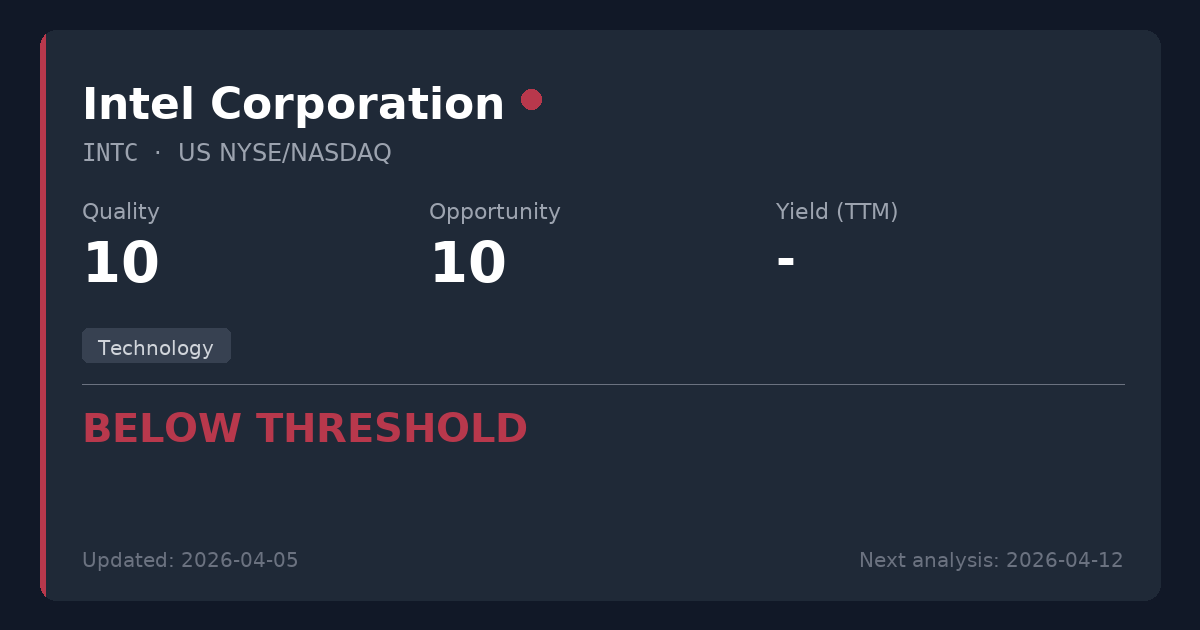
Scores
Key Metrics
Powered by EODHDP/E (TTM)
N/A
P/E (Price-to-Earnings)Shows how much investors pay for each $1 of profit. We display the TTM P/E (Trailing Twelve Months) which uses actual earnings from the last 4 quarters. This is more reliable than Forward P/E which uses analyst estimates.
TTM period through: 2026-06-30
Why N/A?
EPS (TTM) = -2.12 (negative or zero)
Cannot calculate P/E with negative earnings.
Forward P/E (estimated): 63.3
Based on analyst estimates
Reference: Provider P/E (Forward): 63.3
Net Debt/EBITDA (TTM)
5.7x
Net Debt / EBITDAA leverage ratio showing how many years of EBITDA (earnings before interest, taxes, depreciation, and amortization) it would take to repay net debt. EBITDA approximates operating cash generation. Lower ratios (e.g., <3x) are generally safer; higher (e.g., >5x) may indicate more financial risk.
TTM through: 2026-06-30
The quarterly value can spike when quarterly EBITDA is very low (e.g., one-time charges).
Quick guide: <2x manageable, >4x can be risky (sector-dependent).
ROE
-10.7%
ROE (Return on Equity)A profitability measure: how much profit is generated from shareholders’ equity. Higher isn’t always better if it comes from high debt.
EV/EBITDA
182.0x
EV/EBITDAA valuation ratio that compares total business value (including debt) to EBITDA. Lower can mean cheaper, but context matters.
Dividend Summary
Powered by EODHDDiv. Growth (5Y)
-21.4%
Summary
Intel is undergoing a highly capital-intensive and inherently risky structural transformation amid intense competitive pressure and secular disruption away from its core x86 architecture. The combination of chronic net losses, an elevated debt load, and consecutive deep dividend cuts makes this completely unsuitable for a dividend growth strategy. Not recommended for new positions.
Sector Context
Intel designs and manufactures microprocessors and chipsets for the global technology market. For DGI investors, the technology sector generally carries a strict strategy-fit penalty, which becomes prohibitive when a highly capital-intensive business model results in deeply negative earnings and repeated dividend cuts.
📊 Strategy Analysis
- • Beneficiary of the U.S. CHIPS Act and Section 48D investment credits (25% tax credit) which subsidize its massive capital expenditures.
- • Secured a favorable legal resolution in December 2025 that reduced its European Commission antitrust fine by €140 million down to €237 million.
- • Dismissal of the shareholder class action lawsuit in March 2025 regarding its foundry segment operating losses.
⚠ What to Watch
- • Fundamentally broken capital return profile marked by consecutive ~49% dividend cuts in 2023 and 2024, compounded by ongoing shareholder dilution (Total Shareholder Yield of -4.07%).
- • Severe structural fundamental deterioration, evidenced by 7 net loss quarters in the last 8 and a deeply negative ROE of -10.72%.
- • Elevated financial leverage with a Net Debt/EBITDA ratio of 5.67x amidst massive, ongoing capital requirements for its internal foundry pivot.
- • Structural obsolescence risks to its foundational x86 architecture from competing ARM/RISC-V designs and alternative accelerated computing platforms.
📊 Historical Trends (10 Years)
Powered by EODHDThese charts show how key metrics have evolved over the past decade, helping you identify if the company is improving or deteriorating.
Debt Evolution (Net Debt / EBITDA)
Lower values are better. A declining trend indicates the company is reducing its debt (deleveraging).
Revenue & Earnings Growth
Consistent growth in revenueRevenue
The money a company brings in from selling its products or services. It’s the top line before costs. (blue) and earningsEarnings (Profit)
What’s left after expenses. Positive earnings mean the business made a profit; negative means a loss. (green) indicates a healthy business. Look for upward trends and recoveries after temporary dips.
Dividend Sustainability (FCF vs Dividends Paid)
Free cash flowFree Cash Flow
Cash left after the company pays for running the business and maintaining it. Often used to fund dividends, pay debt, or buy back shares. (FCFFCF (Free Cash Flow)
Short for Free Cash Flow: cash left after operating needs and maintenance spending., blue) should cover dividends paidDividends Paid
Cash the company paid out to shareholders. It’s not guaranteed and can change over time. (green). If dividends consistently exceed FCFFCF (Free Cash Flow)
Short for Free Cash Flow: cash left after operating needs and maintenance spending., the dividend may be at risk.
Analysis date: 2026-10-17
Disclaimer: This information is for educational purposes only. Not financial advice.