3 months Premium FREE
No credit card. No commitment.
Microsoft Corporation
🇺🇸 MSFT · NYSE/NASDAQ
Technology
Price at analysis: USD 534.25 Current price: USD 536.57 * updated every night
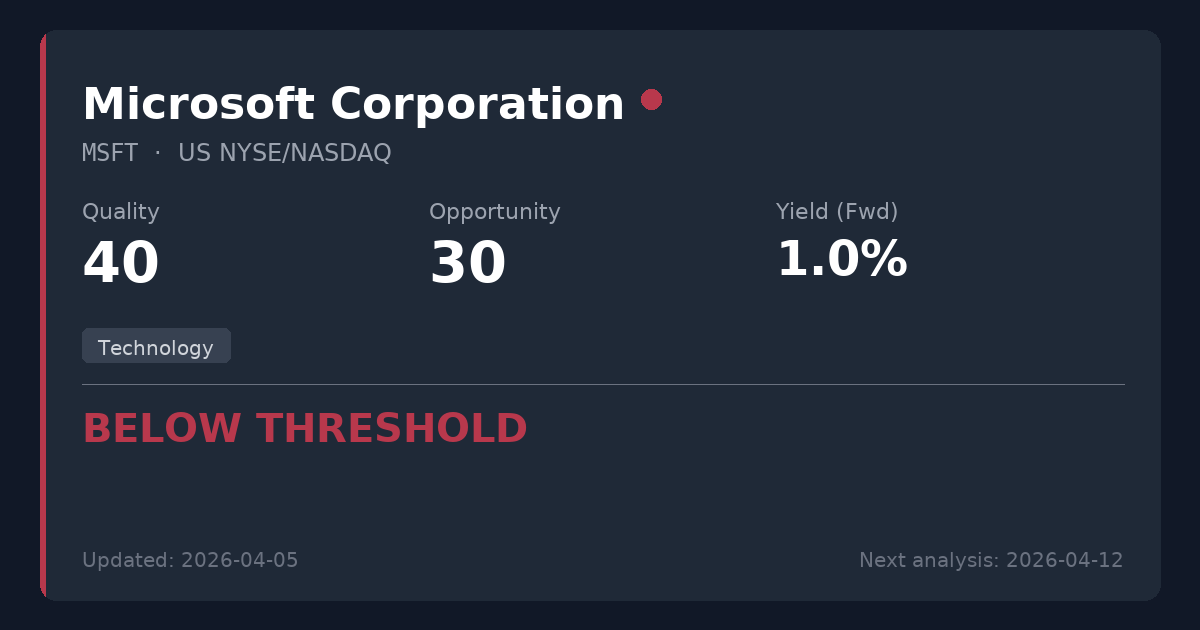
Scores
Key Metrics
Powered by EODHDP/E (TTM)
29.8
P/E (Price-to-Earnings)Shows how much investors pay for each $1 of profit. We display the TTM P/E (Trailing Twelve Months) which uses actual earnings from the last 4 quarters. This is more reliable than Forward P/E which uses analyst estimates.
Calculation: 534.25 ÷ 17.95 = 29.8
TTM period through: 2026-06-30
Forward P/E (estimated): 25.1
Based on analyst estimates
Reference: Provider P/E (Trailing): 30.3
Net Debt/EBITDA (TTM)
0.2x
Latest quarter: 0.9x
Net Debt / EBITDAA leverage ratio showing how many years of EBITDA (earnings before interest, taxes, depreciation, and amortization) it would take to repay net debt. EBITDA approximates operating cash generation. Lower ratios (e.g., <3x) are generally safer; higher (e.g., >5x) may indicate more financial risk.
TTM through: 2026-06-30
Latest quarter (2026-06-30): 0.9x
The quarterly value can spike when quarterly EBITDA is very low (e.g., one-time charges).
Quick guide: <2x manageable, >4x can be risky (sector-dependent).
ROE
34.0%
ROE (Return on Equity)A profitability measure: how much profit is generated from shareholders’ equity. Higher isn’t always better if it comes from high debt.
EV/EBITDA
17.7x
EV/EBITDAA valuation ratio that compares total business value (including debt) to EBITDA. Lower can mean cheaper, but context matters.
Dividend Summary
Powered by EODHDDividend Yield (Fwd)
0.96%
TTM: 0.68%
Dividend YieldThe Forward yield (Fwd) shows the next announced annual dividend / current price — what you'd earn going forward. The Trailing yield (TTM) in the tooltip shows dividends actually paid in the last 12 months. Forward is shown as primary because it reflects the company's current commitment to shareholders.
Forward Yield (estimated): 0.96%
Trailing Yield (TTM, last 12 months): 0.68%
Payout Ratio (Fwd)
21.8%
TTM: 19.8%
Payout RatioDividends as a percentage of earnings. The Forward payout (Fwd) uses the announced dividend divided by actual past earnings (TTM) — it tells you if the company can afford what it promised. Very high payouts can be risky, especially if profits fall.
Announced dividend / actual earnings (TTM)
Payout (Fwd): 21.8%
Payout (TTM): 19.8%
Cash Flow Payout (TTM): 14.5%
FCF Coverage (TTM): 2.53x
Growth Streak
8 yrs
Consec. increases
Div. Growth (5Y)
10.2%
Dividend History
EODHD Dividends API| Status | Type | Decl. Date | Ex-Div Date | Pay Date | Currency | Amount |
|---|---|---|---|---|---|---|
| Forecast* | Quarterly | — | 20 Aug 2027 | — | USD | 0.91 |
| Forecast* | Quarterly | — | 21 May 2027 | — | USD | 0.91 |
| Forecast* | Quarterly | — | 19 Feb 2027 | — | USD | 0.91 |
| Declared | Quarterly | 14 Sep 2026 | 19 Nov 2026 | 10 Dec 2026 | USD | 0.98 |
| Paid | Quarterly | 10 Jun 2026 | 20 Aug 2026 | 10 Sep 2026 | USD | 0.91 |
| Paid | Quarterly | 10 Mar 2026 | 21 May 2026 | 11 Jun 2026 | USD | 0.91 |
| Paid | Quarterly | 02 Dec 2025 | 19 Feb 2026 | 12 Mar 2026 | USD | 0.91 |
| Paid | Quarterly | 15 Sep 2025 | 20 Nov 2025 | 11 Dec 2025 | USD | 0.91 |
* Extrapolated from past dividend history. Not an official announcement — treat as an estimate, not a confirmed date or amount.
Summary
Microsoft is an elite enterprise powerhouse with pristine margins and successful recent resolutions to several major regulatory challenges. However, it fundamentally does not fit a traditional Dividend Growth Investing framework. The highly elevated 29.77x P/E ratio and microscopic 0.68% dividend yield make it an BELOW THRESHOLD for conservative income portfolios, as it offers neither the entry valuation nor the baseline yield required by the strategy.
Sector Context
Microsoft operates in the Technology sector as a dominant software and cloud infrastructure provider. While it is an exceptional business, its heavy capital reinvestment requirements, buyback-first capital return model, and sub-1% yield trigger a structural strategy-fit penalty for traditional DGI portfolios.
📊 Strategy Analysis
- • Elite profitability metrics driven by an irreplaceable enterprise moat, featuring a 34.04% ROE and 62.54% EBITDA margin.
- • Pristine balance sheet with a Net Debt/EBITDA ratio of just 0.25x and massive free cash flow covering the dividend 2.53x over.
- • Major regulatory overhangs have been successfully resolved, including the dismissal of the FTC's Activision challenge and the settlement of the EU Teams probe without fines.
- • Declared an upcoming 9.1% dividend raise to $3.71, demonstrating consistent growth despite the low starting yield.
⚠ What to Watch
- • Microscopic 0.68% TTM dividend yield fundamentally fails to provide meaningful income for a strict Dividend Growth Investing strategy.
- • Highly elevated valuation with a 29.77x TTM P/E, falling entirely outside the targeted 8-15x DGI value range and offering zero margin of safety.
- • Faces an unresolved structural liability regarding a $28.9 billion IRS transfer pricing demand that remains in administrative appeal.
📊 Historical Trends (10 Years)
Powered by EODHDThese charts show how key metrics have evolved over the past decade, helping you identify if the company is improving or deteriorating.
Debt Evolution (Net Debt / EBITDA)
Lower values are better. A declining trend indicates the company is reducing its debt (deleveraging).
Revenue & Earnings Growth
Consistent growth in revenueRevenue
The money a company brings in from selling its products or services. It’s the top line before costs. (blue) and earningsEarnings (Profit)
What’s left after expenses. Positive earnings mean the business made a profit; negative means a loss. (green) indicates a healthy business. Look for upward trends and recoveries after temporary dips.
Dividend Sustainability (FCF vs Dividends Paid)
Free cash flowFree Cash Flow
Cash left after the company pays for running the business and maintaining it. Often used to fund dividends, pay debt, or buy back shares. (FCFFCF (Free Cash Flow)
Short for Free Cash Flow: cash left after operating needs and maintenance spending., blue) should cover dividends paidDividends Paid
Cash the company paid out to shareholders. It’s not guaranteed and can change over time. (green). If dividends consistently exceed FCFFCF (Free Cash Flow)
Short for Free Cash Flow: cash left after operating needs and maintenance spending., the dividend may be at risk.
Analysis date: 2026-10-17
Disclaimer: This information is for educational purposes only. Not financial advice.