ASML Holding N.V.
🇳🇱 ASML.AS · Amsterdam · NL0010273215
Technology
EUR 1161.00 price at analysis
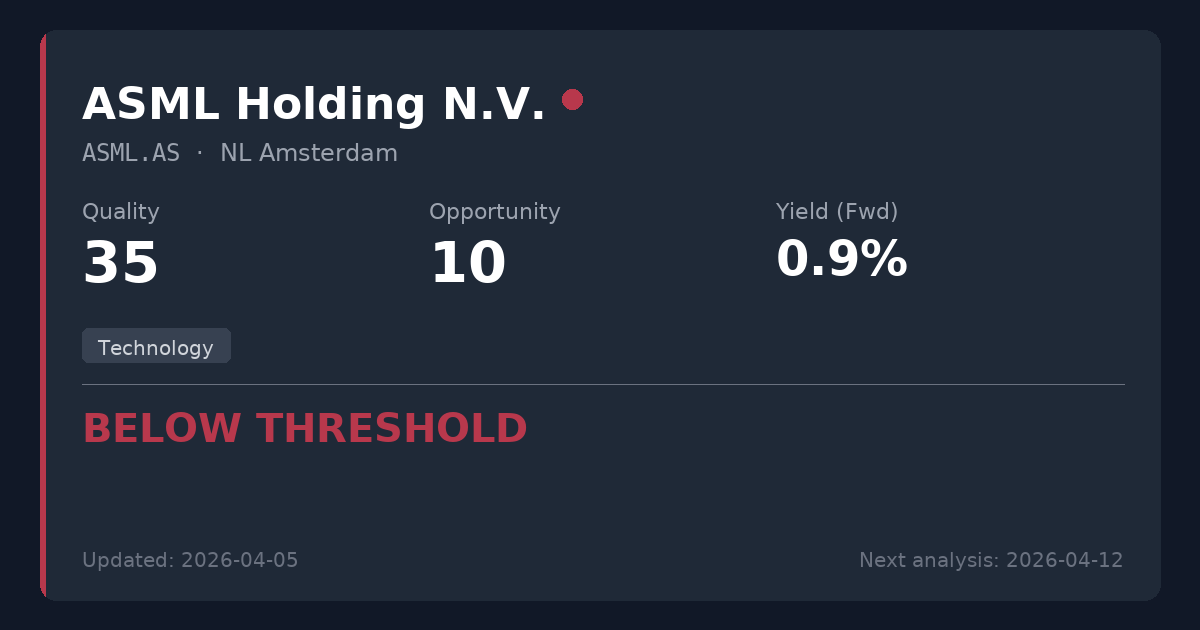
Scores
Key Metrics
Powered by EODHDP/E (TTM)
47.0
P/E (Price-to-Earnings)Shows how much investors pay for each $1 of profit. We display the TTM P/E (Trailing Twelve Months) which uses actual earnings from the last 4 quarters. This is more reliable than Forward P/E which uses analyst estimates.
Calculation: 1161.00 ÷ 24.71 = 47.0
TTM period through: 2025-12-31
Forward P/E (estimated): 40.2
Based on analyst estimates
Reference: Provider P/E (Trailing): 46.9
Yield (Fwd)
0.93%
Dividend YieldThe Forward yield (Fwd) shows the next announced annual dividend / current price — what you'd earn going forward. The Trailing yield (TTM) in the tooltip shows dividends actually paid in the last 12 months. Forward is shown as primary because it reflects the company's current commitment to shareholders.
Trailing Yield (TTM): 0.63%
Net Debt/EBITDA (TTM)
-0.8x
Latest quarter: -2.8x
Net Debt / EBITDAA leverage ratio showing how many years of EBITDA (earnings before interest, taxes, depreciation, and amortization) it would take to repay net debt. EBITDA approximates operating cash generation. Lower ratios (e.g., <3x) are generally safer; higher (e.g., >5x) may indicate more financial risk.
TTM through: 2025-12-31
Latest quarter (2025-12-31): -2.8x
The quarterly value can spike when quarterly EBITDA is very low (e.g., one-time charges).
Quick guide: <2x manageable, >4x can be risky (sector-dependent).
Payout (Fwd)
43.7%
Payout RatioDividends as a percentage of earnings. The Forward payout (Fwd) uses the announced dividend divided by actual past earnings (TTM) — it tells you if the company can afford what it promised. Very high payouts can be risky, especially if profits fall.
Announced dividend / actual earnings (TTM)
Payout (TTM): 26.5%
Cash Flow Payout (TTM): 20.1%
FCF Coverage (TTM): 4.35x
ROE
50.5%
ROE (Return on Equity)A profitability measure: how much profit is generated from shareholders’ equity. Higher isn’t always better if it comes from high debt.
EV/EBITDA
35.8x
EV/EBITDAA valuation ratio that compares total business value (including debt) to EBITDA. Lower can mean cheaper, but context matters.
Summary
ASML is an exceptionally high-quality technology company holding a crucial global monopoly in advanced semiconductor lithography equipment. However, with a negligible 0.63% yield, an extreme valuation at a P/E of 47, and operating in a volatile technology sector, it fundamentally conflicts with our conservative income criteria. Not recommended for new positions given the severe strategy mismatch and lack of margin of safety.
Sector Context
ASML designs and manufactures advanced photolithography machines, holding a critical global monopoly on extreme ultraviolet (EUV) systems essential for modern semiconductor production. While undeniably a tremendous business, the Technology sector is explicitly excluded from this dividend strategy due to rapid innovation cycles, cyclical capital expenditure demands, and historically low dividend yields.
📊 Strategy Analysis
- • Unparalleled global monopoly in advanced semiconductor EUV lithography with massive barriers to entry
- • Pristine balance sheet with a Net Debt/EBITDA of -0.82x and exceptional ROE of 50.5%
- • Robust historical dividend growth and strong Free Cash Flow coverage (4.35x)
⚠ What to Watch
- • Severe strategy mismatch: operates in the explicitly avoided Technology sector, which carries high cyclicality and obsolescence risks
- • Negligible dividend yield of 0.63% falls far below the strategy's 3% minimum requirement
- • Extreme valuation with a TTM P/E of 47x, vastly exceeding the strategy's 8-15x target range and offering no margin of safety
- • High vulnerability to geopolitical tensions and tightening export restrictions
📊 Historical Trends (10 Years)
Powered by EODHDThese charts show how key metrics have evolved over the past decade, helping you identify if the company is improving or deteriorating.
Debt Evolution (Net Debt / EBITDA)
Lower values are better. A declining trend indicates the company is reducing its debt (deleveraging).
Revenue & Earnings Growth
Consistent growth in revenueRevenue
The money a company brings in from selling its products or services. It’s the top line before costs. (blue) and earningsEarnings (Profit)
What’s left after expenses. Positive earnings mean the business made a profit; negative means a loss. (green) indicates a healthy business. Look for upward trends and recoveries after temporary dips.
Dividend Sustainability (FCF vs Dividends Paid)
Free cash flowFree Cash Flow
Cash left after the company pays for running the business and maintaining it. Often used to fund dividends, pay debt, or buy back shares. (FCFFCF (Free Cash Flow)
Short for Free Cash Flow: cash left after operating needs and maintenance spending., blue) should cover dividends paidDividends Paid
Cash the company paid out to shareholders. It’s not guaranteed and can change over time. (green). If dividends consistently exceed FCFFCF (Free Cash Flow)
Short for Free Cash Flow: cash left after operating needs and maintenance spending., the dividend may be at risk.
Analysis date: 2026-04-04
Disclaimer: This information is for educational purposes only. Not financial advice.