3 months Premium FREE
No credit card. No commitment.
Farmers & Merchants Bancorp
🇺🇸 FMCB · NYSE/NASDAQ · US3077951040
Bank
USD 1312.25 price at analysis
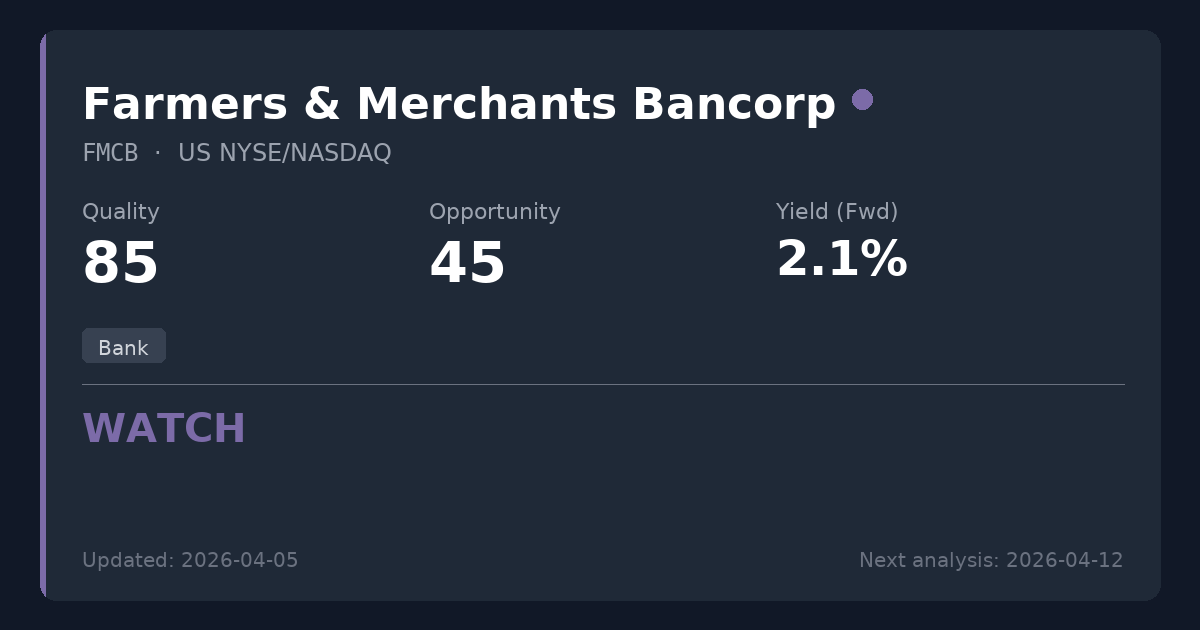
Scores
Key Metrics
Powered by EODHDP/E (TTM)
9.8
P/E (Price-to-Earnings)Shows how much investors pay for each $1 of profit. We display the TTM P/E (Trailing Twelve Months) which uses actual earnings from the last 4 quarters. This is more reliable than Forward P/E which uses analyst estimates.
Calculation: 1312.25 ÷ 133.53 = 9.8
TTM period through: 2026-03-31
Forward P/E (estimated): 11.1
Based on analyst estimates
Reference: Provider P/E (Trailing): 9.7
ROE
15.0%
ROE (Return on Equity)A profitability measure: how much profit is generated from shareholders’ equity. Higher isn’t always better if it comes from high debt.
Dividend Summary
Powered by EODHDDividend Yield (Fwd)
1.56%
TTM: 1.56%
Dividend YieldThe Forward yield (Fwd) shows the next announced annual dividend / current price — what you'd earn going forward. The Trailing yield (TTM) in the tooltip shows dividends actually paid in the last 12 months. Forward is shown as primary because it reflects the company's current commitment to shareholders.
Forward Yield (estimated): 1.56%
Trailing Yield (TTM, last 12 months): 1.56%
Payout Ratio (Fwd)
15.4%
TTM: 14.8%
Payout RatioDividends as a percentage of earnings. The Forward payout (Fwd) uses the announced dividend divided by actual past earnings (TTM) — it tells you if the company can afford what it promised. Very high payouts can be risky, especially if profits fall.
Announced dividend / actual earnings (TTM)
Payout (Fwd): 15.4%
Payout (TTM): 14.8%
Cash Flow Payout (TTM): 16.6%
FCF Coverage (TTM): 5.08x
Growth Streak
8 yrs
Consec. increases
Div. Growth (5Y)
5.6%
Dividend History
EODHD Dividends API| Status | Type | Decl. Date | Ex-Div Date | Pay Date | Currency | Amount |
|---|---|---|---|---|---|---|
| Forecast* | Quarterly | — | 12 Jun 2027 | — | USD | 5.35 |
| Forecast* | Quarterly | — | 11 Mar 2027 | — | USD | 5.1 |
| Forecast* | Quarterly | — | 15 Dec 2026 | — | USD | 5.05 |
| Forecast* | Quarterly | — | 11 Sep 2026 | — | USD | 5 |
| Paid | Quarterly | 12 May 2026 | 12 Jun 2026 | 01 Jul 2026 | USD | 5.35 |
| Paid | Quarterly | 12 Feb 2026 | 11 Mar 2026 | 01 Apr 2026 | USD | 5.1 |
| Paid | Quarterly | 12 Nov 2025 | 15 Dec 2025 | 02 Jan 2026 | USD | 5.05 |
| Paid | Quarterly | 12 Aug 2025 | 11 Sep 2025 | 01 Oct 2025 | USD | 5 |
* Extrapolated from past dividend history. Not an official announcement — treat as an estimate, not a confirmed date or amount.
Summary
Farmers & Merchants Bancorp is an exceptionally well-capitalized regional bank and a premier agricultural lender in California's Central Valley. The company offers profound operational stability, highlighted by a 61-year streak of consecutive dividend increases, a strong 15.05% ROE, and an incredibly robust balance sheet. Trading at an attractive P/E of 9.8, the stock is worth considering for new positions at current levels, offering exceptional dividend safety and compound growth potential for investors willing to accept a lower starting yield.
Sector Context
Regional banks generate revenue primarily through net interest margins, taking in customer deposits and issuing loans. While the banking sector typically operates with high leverage, FMCB is unique as an ultra-conservative community bank and premier agricultural lender in California's Central Valley, whose localized underwriting expertise provides a strong regulatory moat against larger national competitors.
📊 Strategy Analysis
- • Trading at an attractive P/E of 9.8, falling perfectly within the strategy's 8-15x ideal range for quality financial institutions.
- • Exceptional profitability and capital preservation, highlighted by a strong 15.05% ROE and an ultra-conservative Debt/Equity ratio of 0.02, providing massive balance sheet flexibility.
- • Outstanding dividend sustainability and growth, marked by a 61-year streak of consecutive increases and a highly secure 30.7% trailing payout ratio.
- • Deep competitive moat in agricultural lending stemming from hyper-local expertise in California's complex water regulations, allowing FMCB to safely underwrite loans where national competitors cannot.
⚠ What to Watch
- • The trailing dividend yield of 1.56% falls significantly below the strategy's minimum 3% threshold, limiting immediate income generation for yield-focused investors.
- • California's Sustainable Groundwater Management Act (SGMA) poses a long-term structural risk to the broader Central Valley agricultural sector, potentially impacting collateral land values over time.
- • Recent insider selling activity by directors warrants routine monitoring, though core operating fundamentals and capital metrics remain exceptionally robust.
📊 Historical Trends (10 Years)
Powered by EODHDThese charts show how key metrics have evolved over the past decade, helping you identify if the company is improving or deteriorating.
Debt Evolution (Net Debt / EBITDA)
Lower values are better. A declining trend indicates the company is reducing its debt (deleveraging).
Revenue & Earnings Growth
Consistent growth in revenueRevenue
The money a company brings in from selling its products or services. It’s the top line before costs. (blue) and earningsEarnings (Profit)
What’s left after expenses. Positive earnings mean the business made a profit; negative means a loss. (green) indicates a healthy business. Look for upward trends and recoveries after temporary dips.
Dividend Sustainability (FCF vs Dividends Paid)
Free cash flowFree Cash Flow
Cash left after the company pays for running the business and maintaining it. Often used to fund dividends, pay debt, or buy back shares. (FCFFCF (Free Cash Flow)
Short for Free Cash Flow: cash left after operating needs and maintenance spending., blue) should cover dividends paidDividends Paid
Cash the company paid out to shareholders. It’s not guaranteed and can change over time. (green). If dividends consistently exceed FCFFCF (Free Cash Flow)
Short for Free Cash Flow: cash left after operating needs and maintenance spending., the dividend may be at risk.
Analysis date: 2026-07-04
Disclaimer: This information is for educational purposes only. Not financial advice.