3 months Premium FREE
No credit card. No commitment.
Walt Disney Company
🇺🇸 DIS · NYSE/NASDAQ · US2546871060
Communication Services
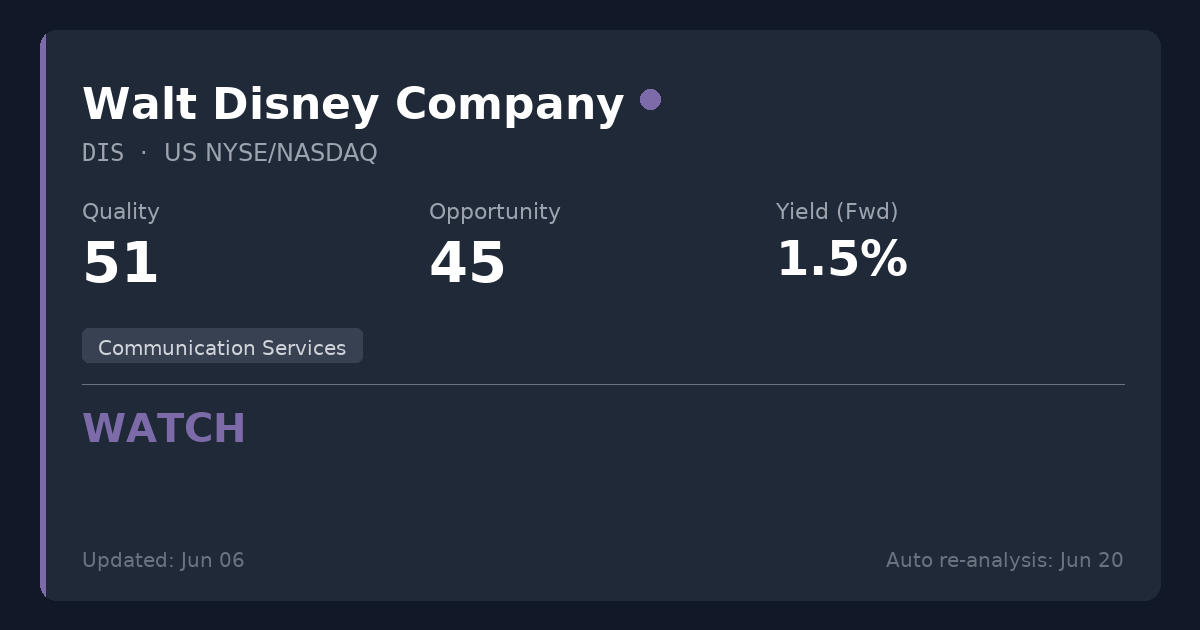
Scores
Key Metrics
Powered by EODHDP/E (TTM)
15.0
P/E (Price-to-Earnings)Shows how much investors pay for each $1 of profit. We display the TTM P/E (Trailing Twelve Months) which uses actual earnings from the last 4 quarters. This is more reliable than Forward P/E which uses analyst estimates.
Net Debt/EBITDA (TTM)
2.1x
Net Debt / EBITDAA leverage ratio showing how many years of EBITDA (earnings before interest, taxes, depreciation, and amortization) it would take to repay net debt. EBITDA approximates operating cash generation. Lower ratios (e.g., <3x) are generally safer; higher (e.g., >5x) may indicate more financial risk.
The quarterly value can spike when quarterly EBITDA is very low (e.g., one-time charges).
Quick guide: <2x manageable, >4x can be risky (sector-dependent).
ROE
11.0%
ROE (Return on Equity)A profitability measure: how much profit is generated from shareholders’ equity. Higher isn’t always better if it comes from high debt.
EV/EBITDA
10.7x
EV/EBITDAA valuation ratio that compares total business value (including debt) to EBITDA. Lower can mean cheaper, but context matters.
Dividend Summary
Powered by EODHDDividend Yield (Fwd)
1.44%
TTM: 1.56%
Dividend YieldThe Forward yield (Fwd) shows the next announced annual dividend / current price — what you'd earn going forward. The Trailing yield (TTM) in the tooltip shows dividends actually paid in the last 12 months. Forward is shown as primary because it reflects the company's current commitment to shareholders.
Forward Yield (estimated): 1.44%
Trailing Yield (TTM, last 12 months): 1.56%
Payout Ratio (Fwd)
25.3% TTM
Payout RatioDividends as a percentage of earnings. The Forward payout (Fwd) uses the announced dividend divided by actual past earnings (TTM) — it tells you if the company can afford what it promised. Very high payouts can be risky, especially if profits fall.
Announced dividend / actual earnings (TTM)
Dividend History
EODHD Dividends API| Status | Type | Decl. Date | Ex-Div Date | Pay Date | Currency | Amount |
|---|---|---|---|---|---|---|
| Forecast* | Semiannual | — | 30 Jun 2027 | — | USD | 0.75 |
| Forecast* | Semiannual | — | 15 Dec 2026 | — | USD | 0.75 |
| Paid | Semiannual | 13 Nov 2025 | 30 Jun 2026 | 22 Jul 2026 | USD | 0.75 |
| Paid | Semiannual | 13 Nov 2025 | 15 Dec 2025 | 15 Jan 2026 | USD | 0.75 |
* Extrapolated from past dividend history. Not an official announcement — treat as an estimate, not a confirmed date or amount.
Summary
While The Walt Disney Company boasts an unparalleled intellectual property moat and an improving balance sheet, the ongoing structural transition away from traditional television makes it a poor fit for our conservative income strategy. The current 1.56% yield falls well short of our requirements, and massive fixed liabilities for sports rights introduce long-term execution risks. Not recommended for new dividend-focused positions, as better income stability exists in essential service sectors.
Sector Context
The Walt Disney Company is a global diversified entertainment conglomerate operating in media networks, theme parks, studio entertainment, and direct-to-consumer streaming. For conservative dividend investors, the media sector presents significant structural challenges as legacy linear television—historically a highly profitable, predictable cash cow—undergoes permanent disruption in favor of capital-intensive streaming models.
Temporary Opportunity Identified
Short-term headwinds including a $50 million streaming antitrust settlement, recent box office comp difficulties, and temporary regulatory friction freezing planned park expansions in Florida have depressed market sentiment.
📊 Strategy Analysis
- • Balance sheet strength is improving significantly, with Net Debt/EBITDA deleveraging from a historical high of 4.7x down to a healthy 2.12x.
- • The recently reinstated and grown dividend is exceptionally well-covered by free cash flow, indicated by a low cash flow payout ratio of just 9.96%.
- • Trading at a P/E of 15.02, valuation sits at the upper edge of our ideal 8-15x range, offering a reasonable entry multiple for a company with an unparalleled global intellectual property moat.
⚠ What to Watch
- • Current trailing dividend yield of 1.56% falls drastically below the strategy's strict >3% minimum requirement for income generation.
- • The core media business is undergoing a permanent structural transition as the historically profitable linear pay-TV dual-revenue model faces terminal obsolescence.
- • Inflexible, multi-billion-dollar off-balance-sheet commitments for long-term sports programming (e.g., $2.6 billion annually for NBA rights) structurally limit capital allocation flexibility.
Analysis date: 2026-07-25
Disclaimer: This information is for educational purposes only. Not financial advice.