3 months Premium FREE
No credit card. No commitment.
Alexandria Real Estate Equities Inc
🇺🇸 ARE · NYSE/NASDAQ · US0152711091
Real Estate
USD 50.18 price at analysis
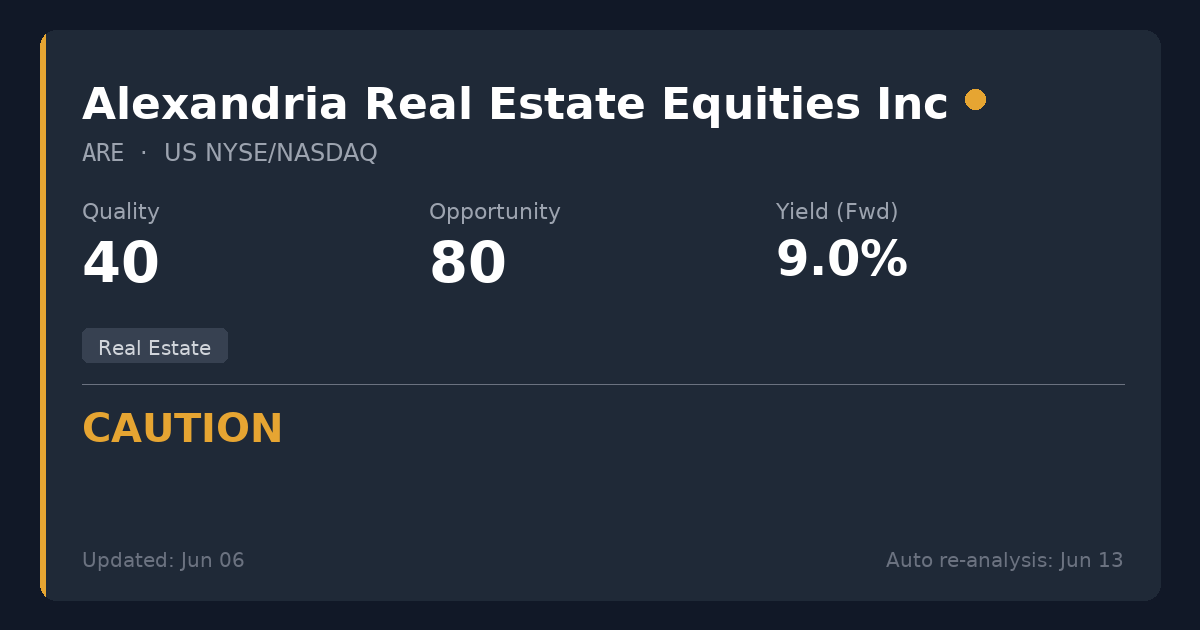
Scores
Key Metrics
Powered by EODHDP/E (TTM)
N/A
P/E (Price-to-Earnings)Shows how much investors pay for each $1 of profit. We display the TTM P/E (Trailing Twelve Months) which uses actual earnings from the last 4 quarters. This is more reliable than Forward P/E which uses analyst estimates.
TTM period through: 2026-03-31
Why N/A?
EPS (TTM) = -6.23 (negative or zero)
Cannot calculate P/E with negative earnings.
Forward P/E (estimated): 16.7
Based on analyst estimates
Reference: Provider P/E (Forward): 16.7
Net Debt/EBITDA (TTM)
30.7x
Net Debt / EBITDAA leverage ratio showing how many years of EBITDA (earnings before interest, taxes, depreciation, and amortization) it would take to repay net debt. EBITDA approximates operating cash generation. Lower ratios (e.g., <3x) are generally safer; higher (e.g., >5x) may indicate more financial risk.
TTM through: 2026-03-31
The quarterly value can spike when quarterly EBITDA is very low (e.g., one-time charges).
Quick guide: <2x manageable, >4x can be risky (sector-dependent).
ROE
-4.1%
ROE (Return on Equity)A profitability measure: how much profit is generated from shareholders’ equity. Higher isn’t always better if it comes from high debt.
EV/EBITDA
30.0x
EV/EBITDAA valuation ratio that compares total business value (including debt) to EBITDA. Lower can mean cheaper, but context matters.
Dividend Summary
Powered by EODHDDividend Yield (Fwd)
6.93%
TTM: 6.93%
Dividend YieldThe Forward yield (Fwd) shows the next announced annual dividend / current price — what you'd earn going forward. The Trailing yield (TTM) in the tooltip shows dividends actually paid in the last 12 months. Forward is shown as primary because it reflects the company's current commitment to shareholders.
Forward Yield (estimated): 6.93%
Trailing Yield (TTM, last 12 months): 6.93%
Payout Ratio (Fwd)
689.5% TTM
Payout RatioDividends as a percentage of earnings. The Forward payout (Fwd) uses the announced dividend divided by actual past earnings (TTM) — it tells you if the company can afford what it promised. Very high payouts can be risky, especially if profits fall.
Announced dividend / actual earnings (TTM)
Cash Flow Payout (TTM): 57.4%
FCF Coverage (TTM): 1.74x
Div. Growth (5Y)
2.0%
Dividend History
EODHD Dividends API| Status | Type | Decl. Date | Ex-Div Date | Pay Date | Currency | Amount |
|---|---|---|---|---|---|---|
| Forecast* | Quarterly | — | 30 Jun 2027 | — | USD | 0.72 |
| Forecast* | Quarterly | — | 31 Mar 2027 | — | USD | 0.72 |
| Forecast* | Quarterly | — | 31 Dec 2026 | — | USD | 0.72 |
| Forecast* | Quarterly | — | 30 Sep 2026 | — | USD | 1.32 |
| Paid | Quarterly | 01 Jun 2026 | 30 Jun 2026 | 15 Jul 2026 | USD | 0.72 |
| Paid | Quarterly | 27 Feb 2026 | 31 Mar 2026 | 15 Apr 2026 | USD | 0.72 |
| Paid | Quarterly | 03 Dec 2025 | 31 Dec 2025 | 15 Jan 2026 | USD | 0.72 |
| Paid | Quarterly | 02 Sep 2025 | 30 Sep 2025 | 15 Oct 2025 | USD | 1.32 |
* Extrapolated from past dividend history. Not an official announcement — treat as an estimate, not a confirmed date or amount.
Summary
Alexandria Real Estate Equities operates a premier portfolio of specialized life science properties, but currently faces significant structural transitions and legal headwinds that make it unsuitable for conservative dividend strategies. While the deeply discounted valuation (6.29x P/FFO) and well-covered 6.9% yield offer high upside potential, the emerging threat of lab-space obsolescence from AI-driven drug discovery and ongoing securities fraud litigation present risks that outweigh the attractive price. Not recommended for new core dividend positions.
Sector Context
Alexandria Real Estate Equities is a specialized REIT focused on collaborative life science and agricultural technology campuses. In the REIT sector, traditional GAAP P/E is heavily distorted by non-cash depreciation and impairment charges, making P/FFO and Cash Flow Payout the primary metrics for assessing valuation and dividend sustainability.
Temporary Opportunity Identified
Massive GAAP net losses across recent quarters (including -$1.082B in Q4 2025) are primarily driven by non-cash real estate impairment charges due to market oversupply, temporarily masking the company's underlying positive cash flows (FFO).
📊 Strategy Analysis
- • Deeply undervalued on a cash generation basis, trading at just 6.29x P/FFO and representing a 51.18% discount to its NAV.
- • Despite massive GAAP net losses driven by non-cash real estate impairments, the 6.93% dividend yield remains well-covered by free cash flow (57.4% cash flow payout ratio).
- • The recent 9.8% dividend cut appears to be a prudent strategic reset to self-fund investments and fortify the balance sheet, rather than a sign of acute cash distress.
⚠ What to Watch
- • Emerging structural obsolescence risks threaten the long-term business model, as AI-driven drug discovery and automated robotic 'cloud labs' reduce tenant demand for traditional human-centric lab space.
- • Ongoing securities fraud class action litigation (Hern v. Alexandria) regarding undisclosed lease deterioration at Long Island City compounds governance and execution risks.
- • Reported leverage metrics have deteriorated severely, with Net Debt/EBITDA expanding to 30.72x (up from 6.4x in 2019), exacerbated by billions in recent property value impairments.
Analysis date: 2026-07-18
Disclaimer: This information is for educational purposes only. Not financial advice.