Pfizer Inc
🇺🇸 PFE · NYSE/NASDAQ · US7170811035
Healthcare
USD 28.32 price at analysis
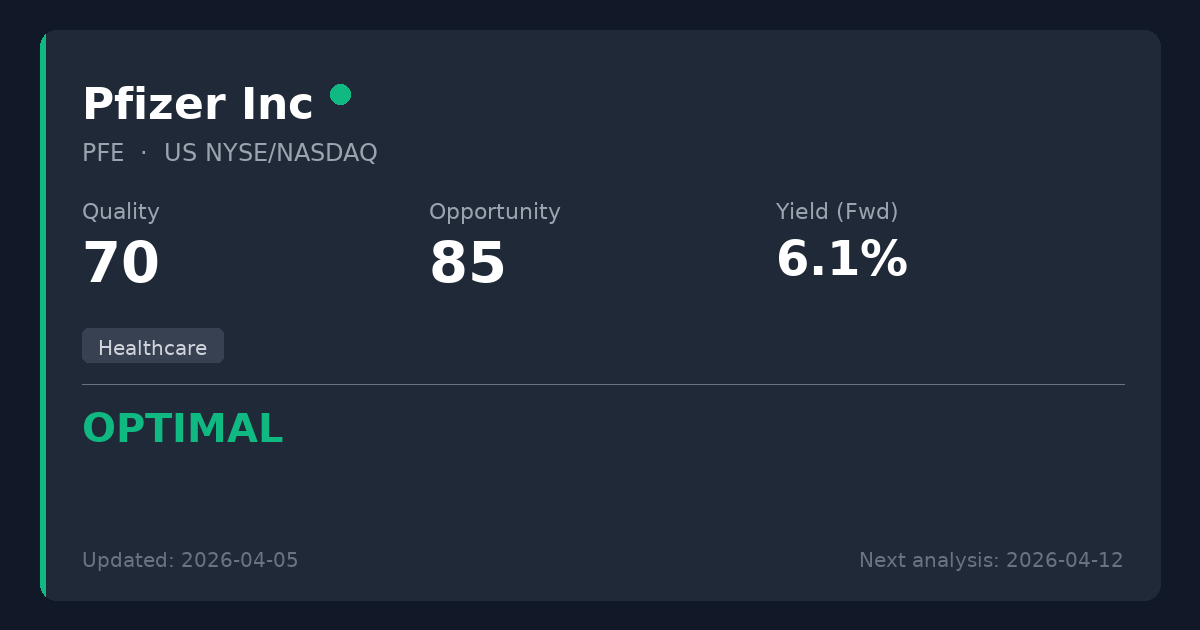
Scores
Key Metrics
Powered by EODHDP/E (TTM)
20.7
P/E (Price-to-Earnings)Shows how much investors pay for each $1 of profit. We display the TTM P/E (Trailing Twelve Months) which uses actual earnings from the last 4 quarters. This is more reliable than Forward P/E which uses analyst estimates.
Calculation: 28.32 ÷ 1.37 = 20.7
TTM period through: 2025-12-31
Forward P/E (estimated): 9.6
Based on analyst estimates
Reference: Provider P/E (Trailing): 20.8
Yield (Fwd)
6.07%
Dividend YieldThe Forward yield (Fwd) shows the next announced annual dividend / current price — what you'd earn going forward. The Trailing yield (TTM) in the tooltip shows dividends actually paid in the last 12 months. Forward is shown as primary because it reflects the company's current commitment to shareholders.
Trailing Yield (TTM): 6.02%
Net Debt/EBITDA (TTM)
4.4x
Latest quarter: 87.7x
Net Debt / EBITDAA leverage ratio showing how many years of EBITDA (earnings before interest, taxes, depreciation, and amortization) it would take to repay net debt. EBITDA approximates operating cash generation. Lower ratios (e.g., <3x) are generally safer; higher (e.g., >5x) may indicate more financial risk.
TTM through: 2025-12-31
Latest quarter (2025-12-31): 87.7x
The quarterly value can spike when quarterly EBITDA is very low (e.g., one-time charges).
Quick guide: <2x manageable, >4x can be risky (sector-dependent).
Payout (Fwd)
125.8%
Payout RatioDividends as a percentage of earnings. The Forward payout (Fwd) uses the announced dividend divided by actual past earnings (TTM) — it tells you if the company can afford what it promised. Very high payouts can be risky, especially if profits fall.
Announced dividend / actual earnings (TTM)
Payout (TTM): 125.8%
Cash Flow Payout (TTM): 83.5%
FCF Coverage (TTM): 0.93x
ROE
8.9%
ROE (Return on Equity)A profitability measure: how much profit is generated from shareholders’ equity. Higher isn’t always better if it comes from high debt.
EV/EBITDA
12.6x
EV/EBITDAA valuation ratio that compares total business value (including debt) to EBITDA. Lower can mean cheaper, but context matters.
Summary
Pfizer is a premier global pharmaceutical leader providing essential healthcare products, with a robust non-COVID portfolio growing at 9% operationally. The recent headline net loss was driven by a temporary, non-cash $4.4 billion R&D impairment charge, which has artificially elevated the TTM P/E to 20.7x while the forward valuation remains highly attractive at 9.6x. Worth considering for new positions at current levels, offering an attractive 6.0% yield for investors willing to look past the temporary accounting noise.
Sector Context
Pfizer is a premier global pharmaceutical company that discovers, develops, and manufactures essential medicines and vaccines. In the healthcare sector, large pharmaceutical firms benefit from patent-protected monopolies on essential life-saving drugs, providing highly defensive and predictable cash flows that are relatively insulated from broader economic cycles.
Temporary Opportunity Identified
A $4.4 billion non-cash intangible asset impairment charge related to R&D pipeline deprioritization artificially depressed TTM earnings and drove a Q4 net loss.
📊 Strategy Analysis
- • The core non-COVID product portfolio demonstrated strong 9% operational growth, validating the underlying business fundamentals.
- • Forward P/E of 9.6x sits perfectly in the optimal 8-15x value range, indicating that the TTM P/E of 20.7x is artificially inflated by the recent one-off charge.
- • The 6.0% dividend yield provides an attractive and substantial income stream while the company executes its cost-cutting initiatives and R&D realignment.
⚠ What to Watch
- • Net Debt/EBITDA of 4.39x exceeds the preferred 3.0x threshold, indicating elevated leverage that warrants ongoing monitoring.
- • Free Cash Flow dividend coverage is tight at 0.93x, leaving a narrow margin of safety for the current dividend payout without operational improvements.
- • The current price of $28.32 trades slightly above our strict historical fair value monopoly upper bound of $24.60, primarily due to the temporarily depressed TTM earnings.
📊 Historical Trends (10 Years)
Powered by EODHDThese charts show how key metrics have evolved over the past decade, helping you identify if the company is improving or deteriorating.
Debt Evolution (Net Debt / EBITDA)
Lower values are better. A declining trend indicates the company is reducing its debt (deleveraging).
Revenue & Earnings Growth
Consistent growth in revenueRevenue
The money a company brings in from selling its products or services. It’s the top line before costs. (blue) and earningsEarnings (Profit)
What’s left after expenses. Positive earnings mean the business made a profit; negative means a loss. (green) indicates a healthy business. Look for upward trends and recoveries after temporary dips.
Dividend Sustainability (FCF vs Dividends Paid)
Free cash flowFree Cash Flow
Cash left after the company pays for running the business and maintaining it. Often used to fund dividends, pay debt, or buy back shares. (FCFFCF (Free Cash Flow)
Short for Free Cash Flow: cash left after operating needs and maintenance spending., blue) should cover dividends paidDividends Paid
Cash the company paid out to shareholders. It’s not guaranteed and can change over time. (green). If dividends consistently exceed FCFFCF (Free Cash Flow)
Short for Free Cash Flow: cash left after operating needs and maintenance spending., the dividend may be at risk.
Analysis date: 2026-04-05
Disclaimer: This information is for educational purposes only. Not financial advice.