3 months Premium FREE
No credit card. No commitment.
Energy Transfer LP
🇺🇸 ET · NYSE/NASDAQ · US29273V1008
Energy
USD 19.73 price at analysis
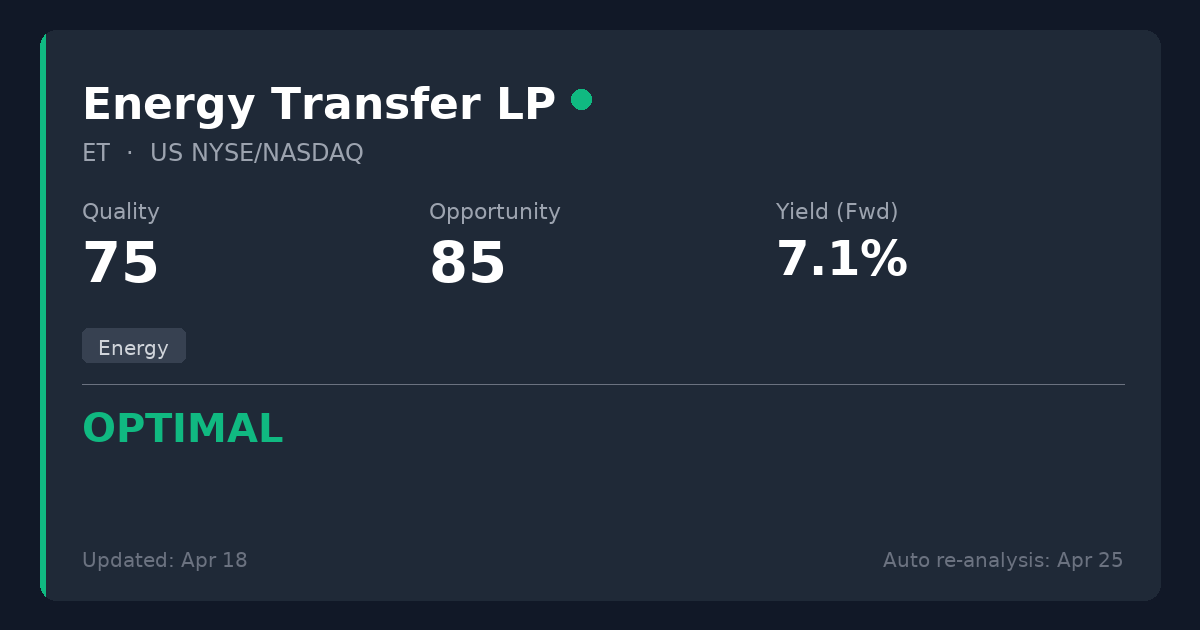
Scores
Key Metrics
Powered by EODHDP/E (TTM)
14.5
P/E (Price-to-Earnings)Shows how much investors pay for each $1 of profit. We display the TTM P/E (Trailing Twelve Months) which uses actual earnings from the last 4 quarters. This is more reliable than Forward P/E which uses analyst estimates.
Calculation: 19.73 ÷ 1.36 = 14.5
TTM period through: 2026-03-31
Forward P/E (estimated): 11.8
Based on analyst estimates
Reference: Provider P/E (Trailing): 16.5
Net Debt/EBITDA (TTM)
4.8x
Latest quarter: 19.0x
Net Debt / EBITDAA leverage ratio showing how many years of EBITDA (earnings before interest, taxes, depreciation, and amortization) it would take to repay net debt. EBITDA approximates operating cash generation. Lower ratios (e.g., <3x) are generally safer; higher (e.g., >5x) may indicate more financial risk.
TTM through: 2026-03-31
Latest quarter (2026-03-31): 19.0x
The quarterly value can spike when quarterly EBITDA is very low (e.g., one-time charges).
Quick guide: <2x manageable, >4x can be risky (sector-dependent).
ROE
12.3%
ROE (Return on Equity)A profitability measure: how much profit is generated from shareholders’ equity. Higher isn’t always better if it comes from high debt.
EV/EBITDA
8.7x
EV/EBITDAA valuation ratio that compares total business value (including debt) to EBITDA. Lower can mean cheaper, but context matters.
Dividend Summary
Powered by EODHDDividend Yield (Fwd)
6.79%
TTM: 6.72%
Dividend YieldThe Forward yield (Fwd) shows the next announced annual dividend / current price — what you'd earn going forward. The Trailing yield (TTM) in the tooltip shows dividends actually paid in the last 12 months. Forward is shown as primary because it reflects the company's current commitment to shareholders.
Forward Yield (estimated): 6.79%
Trailing Yield (TTM, last 12 months): 6.72%
Payout Ratio (Fwd)
98.5%
TTM: 98.5%
Payout RatioDividends as a percentage of earnings. The Forward payout (Fwd) uses the announced dividend divided by actual past earnings (TTM) — it tells you if the company can afford what it promised. Very high payouts can be risky, especially if profits fall.
Announced dividend / actual earnings (TTM)
Payout (Fwd): 98.5%
Payout (TTM): 98.5%
Cash Flow Payout (TTM): 44.7%
FCF Coverage (TTM): 0.77x
Growth Streak
4 yrs
Consec. increases
Div. Growth (5Y)
4.3%
Dividend History
EODHD Dividends API| Status | Type | Decl. Date | Ex-Div Date | Pay Date | Currency | Amount |
|---|---|---|---|---|---|---|
| Forecast* | Quarterly | — | 08 May 2027 | — | USD | 0.338 |
| Forecast* | Quarterly | — | 06 Feb 2027 | — | USD | 0.335 |
| Forecast* | Quarterly | — | 07 Nov 2026 | — | USD | 0.333 |
| Forecast* | Quarterly | — | 08 Aug 2026 | — | USD | 0.33 |
| Paid | Quarterly | 27 Apr 2026 | 08 May 2026 | 20 May 2026 | USD | 0.338 |
| Paid | Quarterly | 27 Jan 2026 | 06 Feb 2026 | 19 Feb 2026 | USD | 0.335 |
| Paid | Quarterly | 28 Oct 2025 | 07 Nov 2025 | 19 Nov 2025 | USD | 0.333 |
| Paid | Quarterly | 24 Jul 2025 | 08 Aug 2025 | 19 Aug 2025 | USD | 0.33 |
* Extrapolated from past dividend history. Not an official announcement — treat as an estimate, not a confirmed date or amount.
Summary
Energy Transfer operates a premier, irreplaceable midstream energy network that generates massive, fee-based cash flows across North America. Trading at $19.73 vs fair value of $40-50 (based on an infrastructure P/FFO multiple of 12-15x), the stock offers over 100% upside to its intrinsic value, making it worth considering for new positions. The highly attractive 6.7% yield is thoroughly covered by distributable cash flows, providing robust income while waiting for this substantial valuation gap to close.
Sector Context
Energy Transfer is a Master Limited Partnership (MLP) that operates one of North America's largest midstream energy portfolios, transporting, processing, and storing natural gas, crude oil, and natural gas liquids (NGLs). For dividend investors, midstream MLPs operate much like toll roads, generating steady, fee-based revenues that are largely insulated from direct commodity price fluctuations, though they typically carry higher debt loads (Net Debt/EBITDA > 4x) and face long-term energy transition risks.
Temporary Opportunity Identified
Sector-wide energy transition fears and persistent regulatory/litigation overhangs have severely compressed the company's valuation multiple, creating a deep discount to the intrinsic value of its cash-generating infrastructure assets.
📊 Strategy Analysis
- • Operates an irreplaceable, monopolistic pipeline network generating largely fee-based revenues that are insulated from direct commodity price volatility.
- • Trading at $19.73, significantly below our infrastructure fair value range of $40-50 (based on 12-15x P/FFO), suggesting over 100% upside potential to true asset value.
- • The 6.7% dividend yield is exceptionally well-covered with an AFFO payout ratio of 25.8% and operating cash flow of $3.4 billion.
- • Recent legal victory securing a $392 million judgment related to Winter Storm Uri strengthens the balance sheet and demonstrates the enforceability of its contracts.
⚠ What to Watch
- • Net Debt/EBITDA of 4.78x exceeds the standard 4.0x threshold, although this elevated leverage profile is customary for capital-heavy midstream MLPs.
- • Persistent litigation and regulatory overhangs, including the Dakota Access Pipeline (DAPL) easement dispute and proposed FERC penalties, create ongoing headline risks.
- • Long-term structural risks exist regarding the secular energy transition away from fossil fuels and potential legislative threats to the MLP tax-exempt status.
📊 Historical Trends (10 Years)
Powered by EODHDThese charts show how key metrics have evolved over the past decade, helping you identify if the company is improving or deteriorating.
Debt Evolution (Net Debt / EBITDA)
Lower values are better. A declining trend indicates the company is reducing its debt (deleveraging).
Revenue & Earnings Growth
Consistent growth in revenueRevenue
The money a company brings in from selling its products or services. It’s the top line before costs. (blue) and earningsEarnings (Profit)
What’s left after expenses. Positive earnings mean the business made a profit; negative means a loss. (green) indicates a healthy business. Look for upward trends and recoveries after temporary dips.
Dividend Sustainability (FCF vs Dividends Paid)
Free cash flowFree Cash Flow
Cash left after the company pays for running the business and maintaining it. Often used to fund dividends, pay debt, or buy back shares. (FCFFCF (Free Cash Flow)
Short for Free Cash Flow: cash left after operating needs and maintenance spending., blue) should cover dividends paidDividends Paid
Cash the company paid out to shareholders. It’s not guaranteed and can change over time. (green). If dividends consistently exceed FCFFCF (Free Cash Flow)
Short for Free Cash Flow: cash left after operating needs and maintenance spending., the dividend may be at risk.
Analysis date: 2026-07-11
Disclaimer: This information is for educational purposes only. Not financial advice.